On this page
TaleShard is a workspace for writing branching narrative — games, interactive fiction, and stories that fork. This post walks through what it does and how to get in first.
Why we built it
Branching narrative is one of the hardest creative problems there is. You aren’t writing a line, you are designing a web: scenes, choices, character state, and consequences that all have to stay coherent while the whole thing keeps growing.
Most writers end up juggling a spreadsheet, a pile of text files, a generic flowchart tool, and whatever the engine expects — none of which were built for narrative. The result is friction where there should be flow.
TaleShard is the tool we wanted to exist.
Nothing here is hardcoded
The thing that makes TaleShard different is that its building blocks are yours, not ours.
- Node types are content. There is no built-in “dialogue node”. A dialogue card, a branch, a code block — each is a definition you can open, edit, and rebuild, with its own fields, controls and bindings. Every project carries its own set, and sharing one is a copy and a paste.
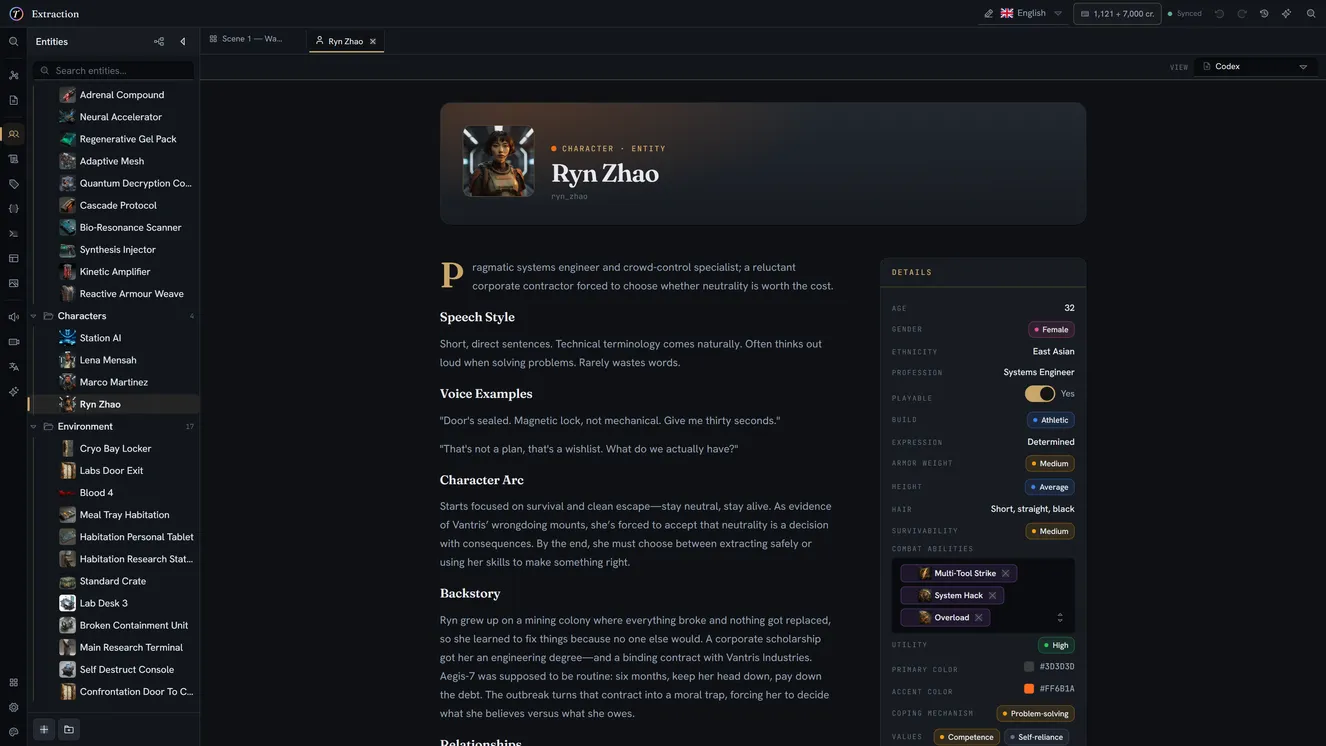
- Entities have as many views as you need. A character is data; how it reads is a separate question. Build a form for entry, a codex page for reading, a stat sheet for balancing — all over the same fields, all editable, arranged on a WYSIWYG canvas that is the real renderer.
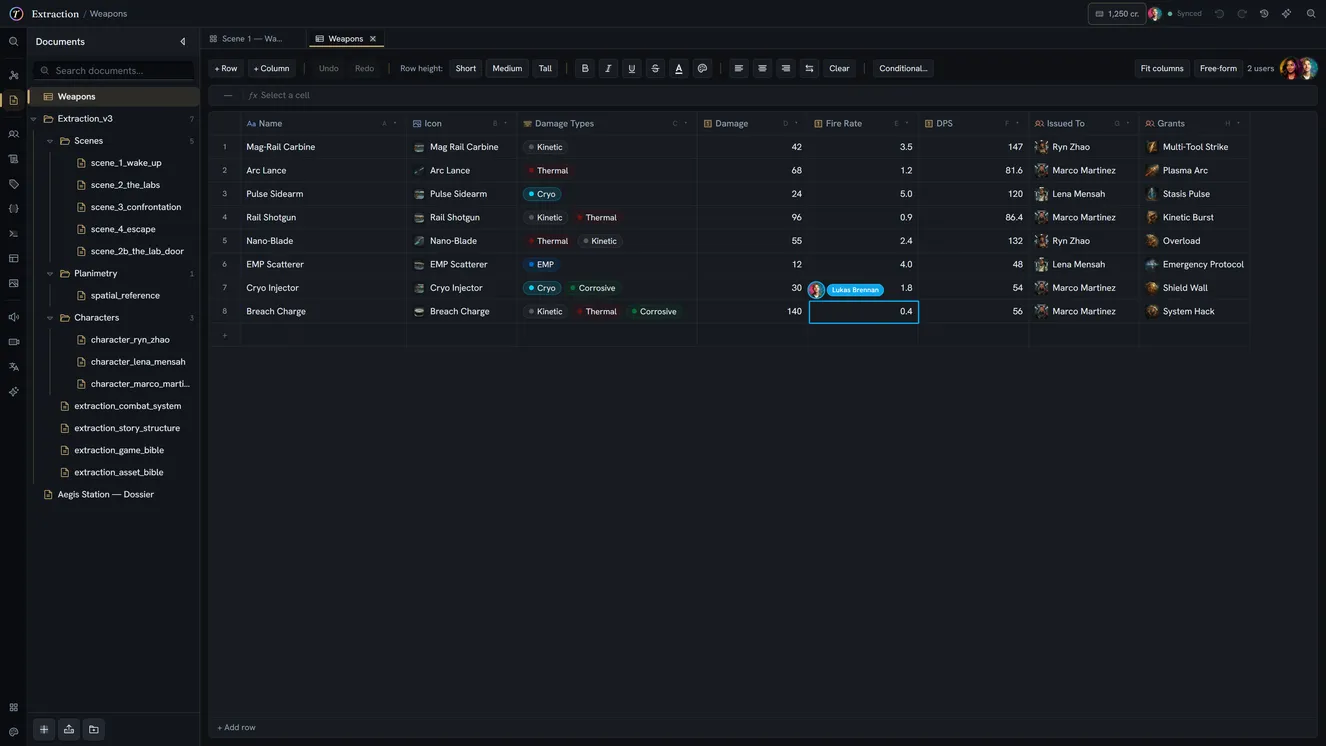
- Your world is a real spreadsheet when you want one. Typed columns that hold entities, media, tag sets and formulas — rendering as pills, thumbnails and chips in every cell. Or open a whole entity type as a table and edit it inline.
The rest of the workspace
Those three are what make TaleShard different. They sit on top of the things any narrative tool has to get right — and those are here too, built rather than bolted on.
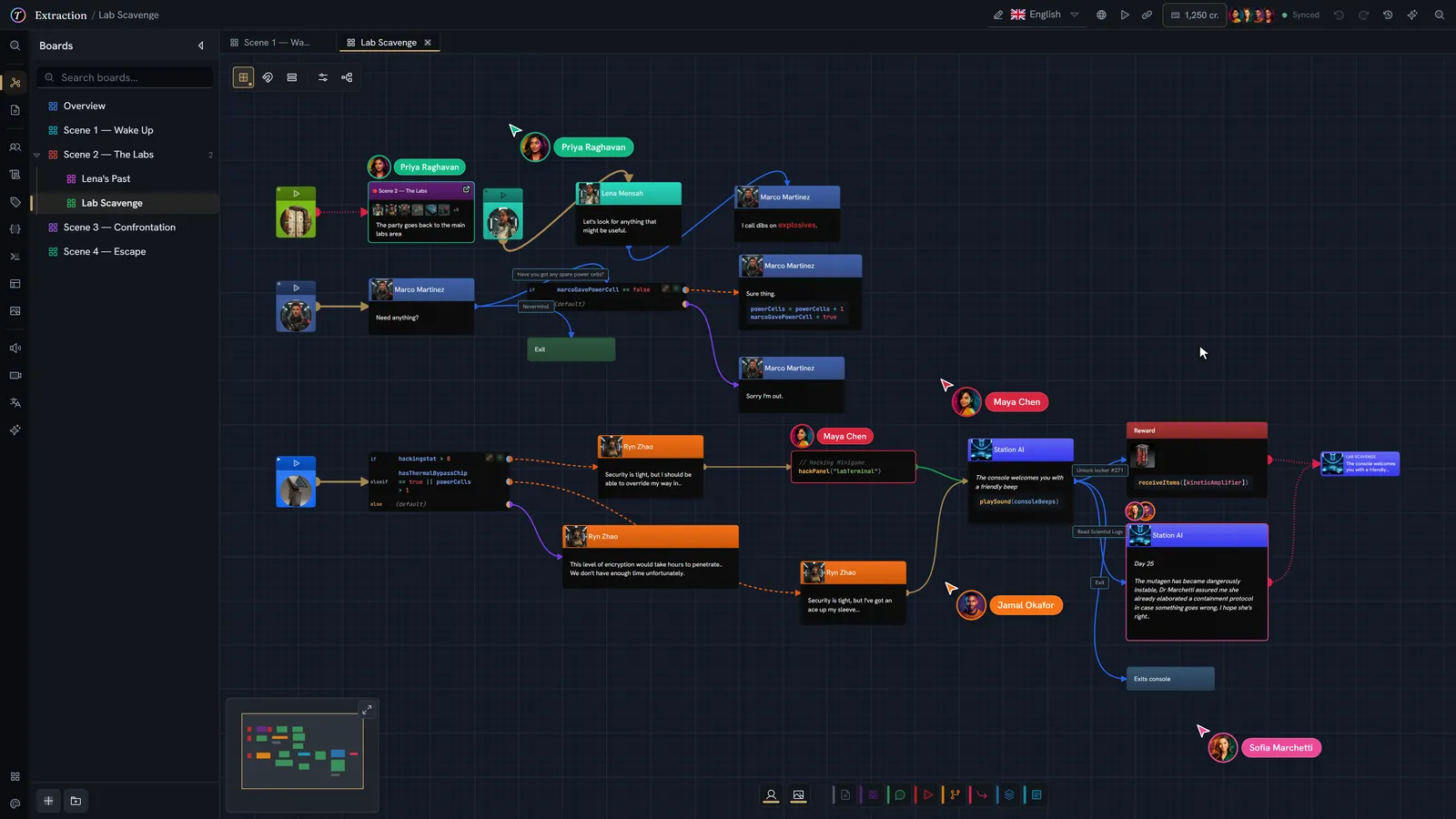
- A visual canvas where the whole story lives as a graph, smooth at hundreds of nodes
- A world model with reusable traits, so your cast and setting stay consistent as they grow
- Conditions without a syntax to learn — a builder for
if/else if, AND / OR, and nested groups, with the full expression editor there when you prefer it - Play mode in the browser — walk the story as a player will, no build step
- Real-time collaboration with live cursors and carets, one shared undo history across boards and data, and one per document
- Localization built in, exported to Excel or XLIFF and imported back
- Voices for every line — design a voice per character, cast it per language, approve a take for each line, and hand a studio the recording script. Music and sound effects too
- Final Draft and Fountain import — bring a screenplay in as a board, with its characters matched to your entities
- Plugins for Unity and Unreal that generate types from your own definitions
See it running
We built three games on TaleShard to prove the last point: Starshined, a roguelike deckbuilder, and Extraction, a turn-based sci-fi RPG, both in Unity; and Breakthrough, a roguelike shoot-‘em-up, in Unreal. The characters, lines, items and fights in all three are records written in TaleShard and synced into the engine. The integrations page puts a board from each beside the moment it becomes in the game.
What’s next
- Guided board generation — live preview while a scene is drafted, with controls for complexity and pacing
Get started
Join the waitlist — accounts unlock in waves, and every invite opens a free beta with the full Team feature set. The plans on the pricing page are what we intend to charge at launch.
Questions or feedback? Find us on X or LinkedIn — or just write to us.